In the previous installment of the John Martinson Project, we examined the early childhood of Jöns Mårtensson. In this post, we’ll look his young adult years in the village of Skoglösa in his newly-adopted parish of Önnestad.
This post is the sixth in the John Martinson Project series
From birth to age 12, Jöns lived in the parish of Östra Vemmenhög in Skåne province. Then the family moved to nearby Skivarp parish, where Jöns’ father had grown up. At age 24, Jöns moved quite some distance to Önnestad parish. As discussed last time, the records don’t show any clear indication as to why he might have moved such a great distance from home.
He settled into the village of Skoglösa, a collection of farmsteads and cottages surrounded by productive farmland. The cottages were numbered 1 through 18. Upon his arrival, Jöns landed at No. 5 & 14 – apparently two cottages that had either been merged together or at least operated as a single unit. Records show lots of dräng (farmhands) and pigor (maids) coming and going, so these cottages were likely intended for transient farmworkers. At this point, Jöns seemed to have found a work situation that was more to his liking. He stayed at No 5 & 14 for about six years.1 In 1862, his younger brother Lars joined him there.2
Besides a stable work situation, Jöns also became part of a tight-knit community of farm workers. He also found a wife from the neighboring parish of Norra Strö. Nilla Svensdotter lived with her father Sven Hansson at No. 4 Kålaberga, just two miles by road from Skoglösa.3
Nilla had two older sisters. The oldest, Bengta, had died when Nilla was 19 years old.4 Two years later, Nilla’s mother died.5 The following year, 1859, her other sister Anna married and moved way to the north near Uppsala.6 By this time Sven was sixty and he was either too old or too sick to work. He was listed as “Inhyses“, meaning “lodger”. By the time Jöns came courting, Nilla and her father had been alone together at No. 4 Kålaberga for five years.7
As was customary, the wedding was to take place in the bride’s church, Norra Strö. Even though he only lived a couple miles away, Jöns had to provide a document from his church, Önnestad, certifying that he was free to marry and was in good standing with the church. That document is preserved in the Swedish National Archives:8
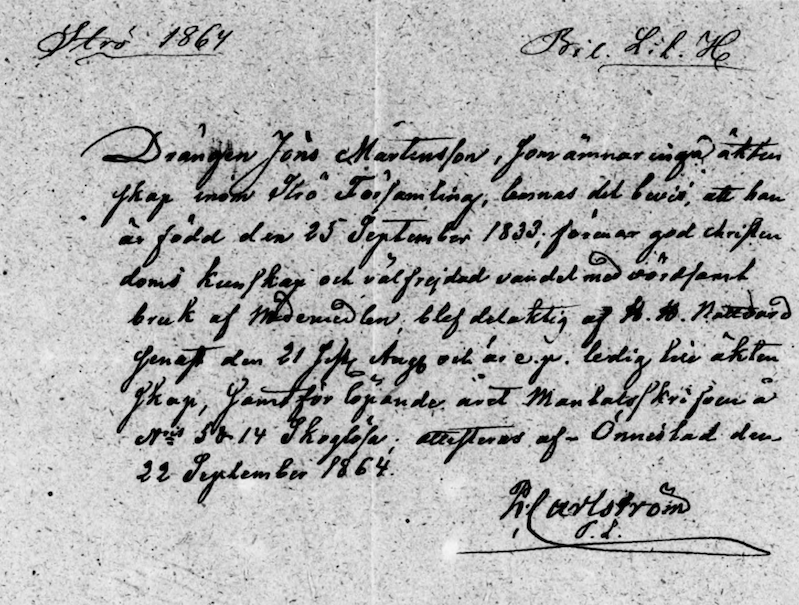
The document translates roughly as follows:
The farmhand Jöns Mårtensson, who intends to enter into marriage within the Strö Parish, is hereby granted this certificate that he was born on September 25, 1835, possesses good Christian knowledge and well-reputed conduct, and has unrestricted use of the Sacraments. He partook of Holy Communion immediately on September 21, 1864, and is here legally free to marry, having been registered in the previous year’s Tax Census (Mantalskrifning) No. 38, at 14 Skogslösa (a place name). Certified by Önnestad on September 22, 1864.
Having been certified as free to marry, banns were first read in the Norra Strö church on September 25, 1864.9 The marriage ceremony took place on November 8, 1864. The couple stayed on at No. 5 & 14 Skoglösa for the following season, welcoming a son Anders to the family on July 21, 1865.10 In October, the family moved to No. 6 Skoglösa, where Jöns is identified as “åbo”, meaning that he is leasing a small farm.11 To hold his lease, he probably owed a cash rent to his landlord, plus possibly some of the farm’s yield. With more children on the way, Jöns had to do more than just scratch out a living on his little farm. He also acquired woodworking skills and was known as a wagon maker.
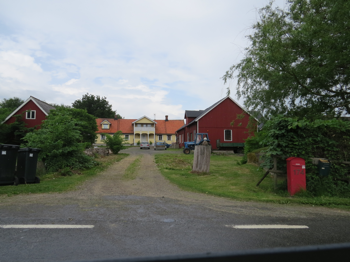
During his years at Skoglösa, Jöns found a community of like-minded farmers, some of whom would become life-long friends. We know for sure that he was close to the following individuals:
- Pehr Nilsson, 13 years older than Jöns, lived at No. 4 Skoglösa with his wife and four children.12
- Jeppa Olsson, 5 years older than Jöns, lived at No. 7 Skoglösa with his wife and five children.13
- Olof Andersson, 3 years older than Jöns, lived at No. 8 Skogösa but later moved to No. 42 Önnestad with his wife and four children.14
- Nils Abrahamsson, 11 years older than Jöns, also lived at No. 6 Skoglösa with his wife and three children. Later in life, Nils took the surname “Aspengren”.15
It’s interesting that he sought out friendships with men who were older – suggesting a seriousness of mind that is evident throughout his life.
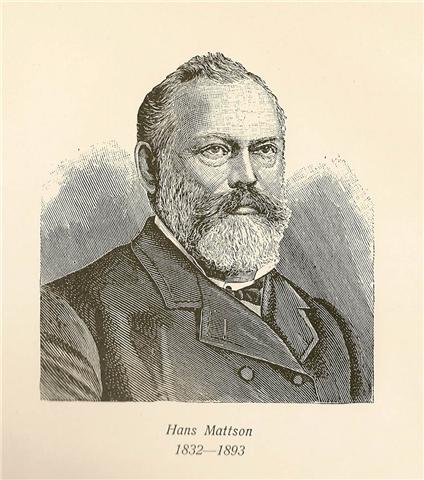 No. 6 Skoglösa had a famous former resident: Hans Mattson, who had moved to America in 1851. Hans had farmed successfully in Illinois and Minnesota. He had studied law on his own and had passed the Minnesota bar. He had gone on to great military success during the Civil War in the 3rd Minnesota Volunteer Infantry Regiment, eventually becoming a colonel. After the war, the State of Minnesota recruited him to serve on the State Board of Emigration and he was tasked with recruiting more emigrants, especially Swedes, to Minnesota.16
In the fall of 1868, Colonel Mattson traveled to Sweden. In the course of his recruitment duties he decided to ring in the New Year at his old home at No. 6 Skoglösa. As he described his life in America and the opportunities it offered, he found a receptive audience amongst the farmers there. The region was reeling from years of famine. The year 1867 had been unusually cold, with snow on the ground in some places well into June. 1868 had been extremely dry, with a failed harvest and widespread loss of livestock. Mattson told of free land available in America through the Homestead Act – but he advised them to act quickly as the most fertile lands were being snapped up by early settlers. Word spread quickly around the region. By the spring of 1869, there were hundreds of families from throughout Skåne clamoring to join Mattson upon his return to Minnesota. More than 70 people would leave for America from the little parish of Önnestad, among them Jöns Mårtensson, his brother Lars, and their four friends.
In his memoir, Hans recounts an interesting anecdote about his visit to No. 6 Skoglösa:
I visited the little cottage where I was born, and where a number of the neighbors had now gathered to see me. One of my earliest recollections from childhood was the spruce tree [that] was planted in the little garden by my parents. It was the only tree of its kind for a great distance around. It had grown to be a foot in diameter, was very beautiful, and was the pride not only of the present owner of the little farm, but of the whole neighborhood. After breaking off a sprig or two of the tree to carry back to my parents, we left the place early in the evening for Nils Bengtson’s home, which was about half a mile distant, and where I was still a guest. Early the next morning my host awoke me with the news that the owner of the cottage had arrived before daylight, anxious to communicate a strange accident. Upon being admitted he stated that shortly after I left his house in the evening, a single gust of wind swept by in great force and broke the spruce tree off with a clean cut a few feet from the ground. It seemed very strange to us all, and he regarded it as an ill-omen, sold the place shortly afterward, and went with me to America the following spring.
I wonder, was Jöns the man who reported the fallen tree? Do I owe my very existence to a freak gust of wind in Sweden in 1869?
The two men from No. 6 Skoglösa who left for America were Jöns Mårtensson and Nils (Abrahamsson) Aspengren, so I guess there’s a 50/50 chance.
Next time, we will examine the logistics of emigration for Jöns and his friends.
1 Önnestad (L) AI:10 (1855-1861) Image 239 / Page 240 (AID: v102365.b239.s240, NAD: SE/LLA/13507)
2 Önnestad (L) AI:11 (1862-1870) Image 220 / Page 212 (AID: v102366.b220.s212, NAD: SE/LLA/13507)
3 Norra Strö (L) AI:6 (1858-1868) Image 79 / Page 75 (AID: v100485.b79.s75, NAD: SE/LLA/13282)
4 Norra Strö (L) CI:3 (1826-1861) Image 110 / Page 193 (AID: v100495.b110.s193, NAD: SE/LLA/13282)
5 Norra Strö (L) CI:3 (1826-1861) Image 111 / Page 195 (AID: v100495.b111.s195, NAD: SE/LLA/13282)
6 Kungsängen (AB, C) AI:11 (1866-1870) Image 970 / Page 90 (AID: v87701.b970.s90, NAD: SE/SSA/1566)
7 Norra Strö (L) AI:6 (1858-1868) Image 79 / Page 75 (AID: v100485.b79.s75, NAD: SE/LLA/13282)
8 Norra Strö (L) HV:3 (1859-1880) Image 97 (AID: v1025618.b97, NAD: SE/LLA/13282)
9 Norra Strö (L) EI:1 (1835-1876) Image 22 / Page 17 (AID: v100499.b22.s17, NAD: SE/LLA/13282)
10 Önnestad (L) AI:11 (1862-1870) Image 220 / Page 212 (AID: v102366.b220.s212, NAD: SE/LLA/13507)
11 Önnestad (L) AI:11 (1862-1870) Image 224 / Page 216 (AID: v102366.b224.s216, NAD: SE/LLA/13507)
12 Önnestad (L) AI:11 (1862-1870) Image 218 / Page 210 (AID: v102366.b218.s210, NAD: SE/LLA/13507)
13 Önnestad (L) AI:11 (1862-1870) Image 227 / Page 219 (AID: v102366.b227.s219, NAD: SE/LLA/13507)
14 Önnestad (L) AI:11 (1862-1870) Image 182 / Page 176 (AID: v102366.b182.s176, NAD: SE/LLA/13507)
15 Önnestad (L) AI:11 (1862-1870) Image 222 / Page 214 (AID: v102366.b222.s214, NAD: SE/LLA/13507)
16 “Reminiscences: The Story of an Emigrant” by Hans Mattson, 1891 (available via Project Gutenberg)

Karen, this a very nice story.
Very interesting story! Love it!