In the previous installment of the John Martinson Project, we looked his young adult years in the village of Skoglösa, including his marriage and friendships, and first-hand reports he heard about the promise of a better life in America. This time, we’ll look at what it took to prepare and embark on his journey to America.
This post is the seventh in the John Martinson Project series.
I should first note that I know a lot about all of this because one of Jöns’ comrades, Nils Aspengren, wrote a memoir filled with specific details about the group’s travels from Sweden. The memoir, written in Swedish, was later translated by a granddaughter of Lars Mårtensson. In 1985, the memoir was also delivered to the American Friends of the Emigrant Institute of Sweden, where Vice President Gunnar Mossblad provided another translation. The two translations are naturally a little bit different, and the Mossblad translation includes several pages of additional material detailing the pioneers early years on their homestead farms and the founding of their church community. I have always taken the memoir material at face value, but as part of this project I wanted to independently verify as much as possible. So far, I can report that everything in the memoir checks out perfectly against available records.
Emigration wasn’t much of a thing in Sweden before the famine of 1867-1869. There had a been a couple of small surges; one to Delaware in the 1600s (less than a thousand people), and then a few religious/idealogical colonies were established in the Midwest (and mostly failed) in the 1840s and 1850s. So when the first really big wave of emigration happened in 1869-1870, there wasn’t much of an “infrastructure” to support mass migration from Sweden. By the late 1870s, however, steamship companies had been established to organize regular transports from Gothenburg, Sweden to Hull, England. There was regular rail service from Hull to Liverpool and of course regular and frequent transatlantic ships departing from Liverpool. There were agents out in the countryside selling “package deals” with all travel completely arranged from their home parish to their final destination – including rail travel within the United States.
But not much of that was in place in 1869. The Skoglösa group was fortunate to have Hans Mattson making all the arrangements. In the meantime, the emigrants had many other personal logistics to manage between New Year’s 1869 and the planned May departure.
The first decision to be made by Jöns and his comrades was whether or not to bring wives and children. We know that Hans Mattson was in Skoglösa the first week of January 1869, encouraging families to consider emigration. That same week, on January 5th, Jöns and Nilla welcomed their third child, baby Elna. Elna had two older brothers, Anders born in 1865 and Nels born in 1866. Jöns (wisely) decided to leave his young family behind, with the intention that they would follow him the next year; presumably land would be procured by then and Jöns would be more ore less settled. As for the other men in the party:
- Pehr Nilsson chose to bring his wife and four children. They had 18-year-old twin boys and two daughters age 10 and 12.
- Jeppa Olsson had a wife and five children. The children ranged in age from 6 to 17. Like Jöns, he planned to get situated before sending for his family to join him.
- Olof Andersson had a wife and four daughters between 1 and 11 years of age. He too chose to leave them behind.
- Nils (Abrahamsson) Aspengren had a wife and three children: two boys age 15 and 13, and a daughter age 10. Nils chose to bring his two teenage boys with him.
- Jöns’ younger brother Lars was single
The next task was to sell everything they owned and, if family was staying behind, make arrangements for their housing for a year.
Some of the emigrants placed notices in the local newspaper and hired auctioneers to oversee the sales, not unlike estate sales we see today. Remarkably, I have been able to find the auction notices for three of the families. Here are images of the newspaper notices and an accompanying English translation.
Nils (Abrahamsson) Aspengren
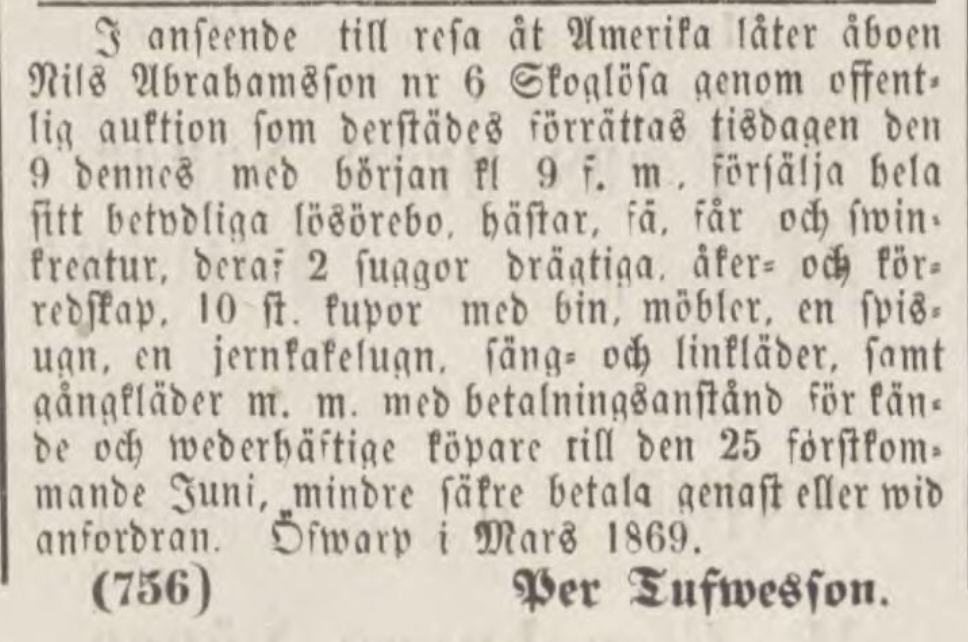
In view of a journey to America, the tenant farmer Nils Abrahamsson, No. 6 Skoglösa, will sell his entire considerable movable property—horses, cattle, sheep, and swine (livestock), thereof 2 pregnant sows, agricultural and transport implements, 10 hives with bees, furniture, a cooking stove, an iron tiled stove, bed- and linen clothes, as well as everyday clothes etc.—by public auction to be held on site, Tuesday, the 9th of this month, starting at 9 a.m. Deferred payment is offered for known and reliable buyers until the upcoming June 25th; less secure (buyers) must pay immediately or upon demand.
(Kristianstadbladet, March 6, 1869, page 5)
Per Nilsson
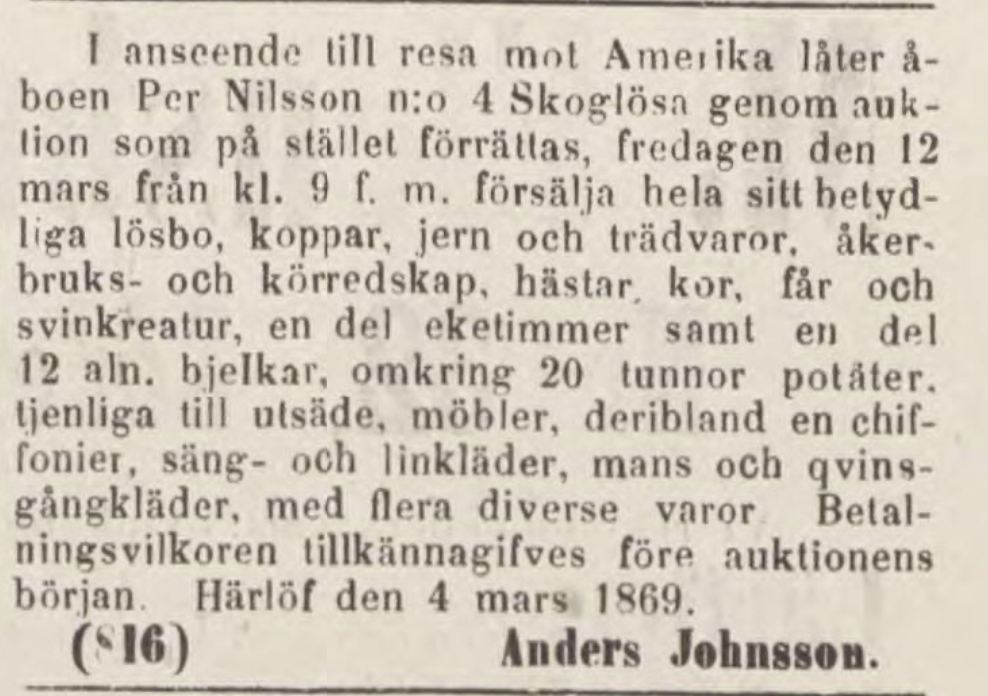
In view of a journey to America, the tenant farmer Per Nilsson, No. 4 Skoglösa, will sell his entire considerable movable property, copper, iron, and wooden goods, agricultural and transport implements, horses, cows, sheep, and swine (livestock), some oak timber as well as some 12 aln. [ells] beams, approximately 20 barrels of potatoes, suitable for seed, furniture, including a chiffonier (chest of drawers), bed- and linen clothes, men’s and women’s everyday clothes, along with several diverse wares, by auction to be held on site, Friday, March 12th, starting at 9 a.m. The payment terms will be announced before the start of the auction.
(Kristianstadbladet, March 6, 1869, page 5)
Jöns Mårtensson
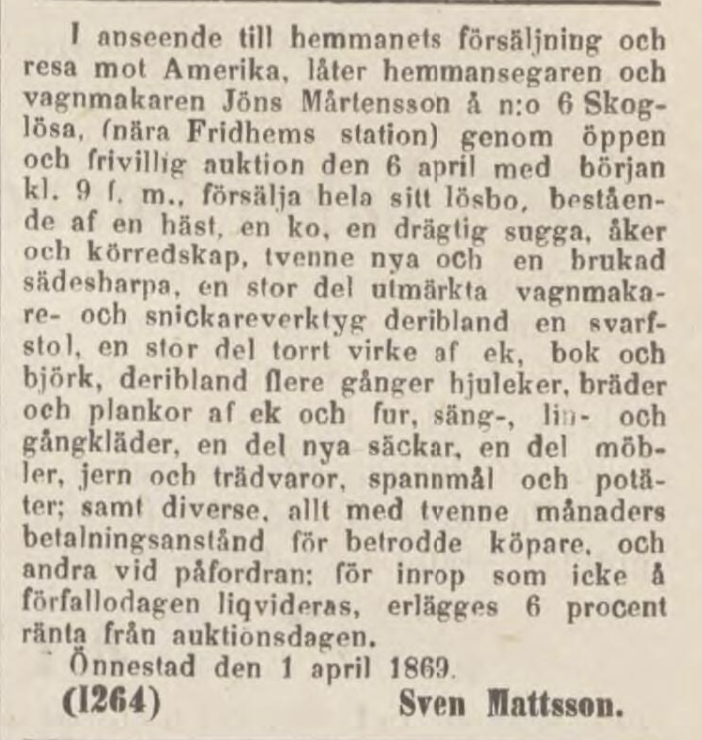
In view of the sale of the farm and a journey to America, the farm owner and wagon maker Jöns Mårtensson, No. 6 Skoglösa, (near Fridhem station) will sell his entire movable property by open and voluntary auction on April 6th, starting at 9 a.m., consisting of one horse, one cow, one pregnant sow, agricultural and transport implements, two new and one used grain screen/sieve, a large quantity of excellent wagon maker and carpenter tools including a turning lathe, a large quantity of dry timber of oak, beech, and birch, including several sets of wheel spokes, boards and planks of oak and pine, bed-, linen- and everyday clothes, some new sacks, some furniture, iron and wooden goods, grain and potatoes; as well as various items, all with two months’ deferred payment for trusted buyers, and for others upon demand; for purchases not liquidated (paid) on the due date, 6 percent interest will be charged from the day of the auction.
(Kristianstadbladet, April 4, 1869, page 3)
An interesting aspect of these advertisements is that you can see that each of these men had “side gigs”. Nils Aspengren had bee hives; Per Nilsson had large beams and transport equipment; Jöns Mårtensson had wagon making tools and supplies. Clearly, farming didn’t provide enough income for a family, you had to have other revenue sources to get by.
The Aspengren diary tells us how the emigration journey unfolded.
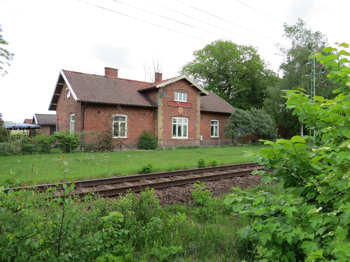
On April 28, 1869, the group from Skoglösa gathered at the Fridhem train station, just one mile down the road from Skoglösa. The vice-pastor of the church was there to send them off. I imagine their families were there, too. Fellow emigrants from other parishes in the area were already on board the train. The train took them to the nearby city of Hässleholm. There they switched trains, boarding a train for Malmö that had been specially commissioned by Col. Mattson. In Malmö, the group boarded a ferry to Copenhagen where they spent the night on board a ship that was at anchor in the harbor. The following day, they went into the city to get their tickets and additional provisions. The next day, Friday, April 30th, they finally boarded their transport ship which was bound for Liverpool, England.
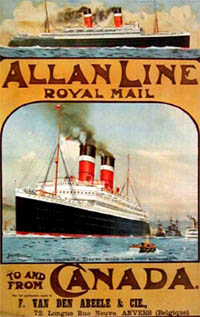
They arrived in Liverpool on Tuesday, May 4th. Then they boarded the transatlantic ship, the S. S. European. The ship was originally known as the William Penn and was built by Malcolmson Bros. in Ireland in 1865. She was purchased by the Allan Line (aka the Montreal Ocean Steamship Company) in 1869 and renamed as the S. S. European. Allan Line ships had distinctive red and black funnels as shown on the poster. Mattson’s emigrants were probably on the first voyage of the ship under its new name. I believe that although it was a steamship, it also had masts and sails, perhaps like the Allan Line’s “Scandinavian”, shown below.
According to an advertisement in the Liverpool Daily Post1, steerage passengers receive “a plentiful supply of cooked provisions, prepared and served up by the Company’s Stewards.” Wine and liquor was not included, but could be purchased on board.

The ship left port on May 8. According to Aspengren, the weather was mostly good and they arrived in Quebec on Sunday, May 23 and 1:00 p.m.
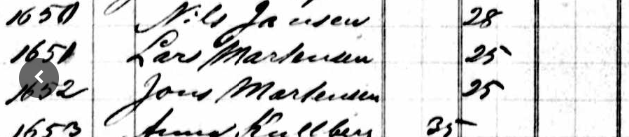
A passenger list was delivered upon arrival in Quebec2, and we see Lars and Jöns listed together.
Next time: finding good land in America.
1 Liverpool Daily Post,May 3, 1869, page 6.
2 Ancestry.com. Canadian Passenger Lists, 1865-1935. Provo, UT, USA: Ancestry.com Operations Inc, 2010.

Very well done!!!! Thank you!
Fascinating information.thanks Karen for all your hard work and research.
Hugs
Bruce Frasier